
Kimi Lu
Vibe Coding Won’t Save the World—Here’s Why
1. The Rise (and Hype) of “Vibe Coding”
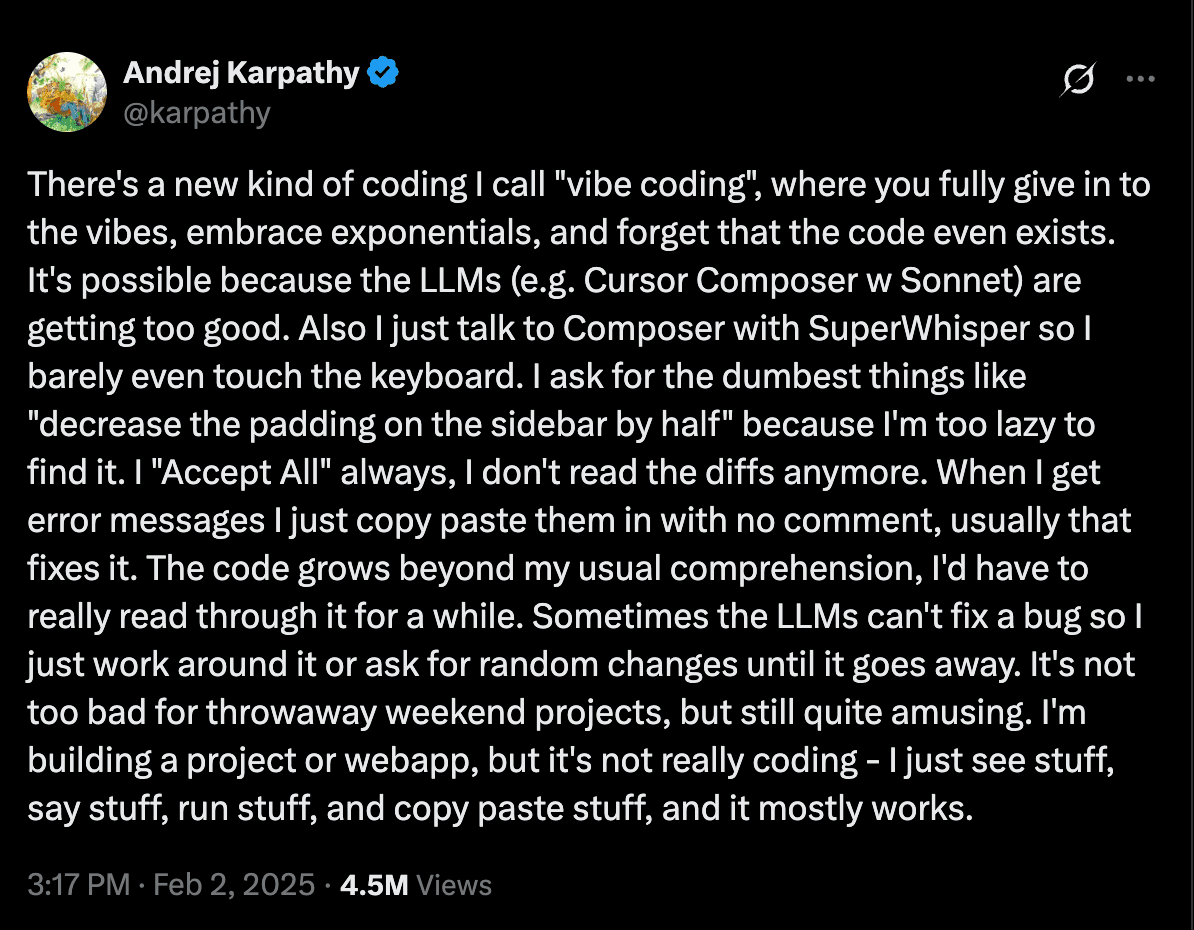
Scroll tech-Twitter for five minutes and you’ll see it: clips of engineers “vibe coding,” pasting vague prompts into an LLM, and watching a React app materialize. It’s entertaining—and undeniably useful for quick experiments—but the narrative that vibe coding will democratize software is dangerously oversold.
2. Software’s Real Bottleneck Isn’t Syntax—It’s Modeling the Problem
• Abstraction > Implementation.
Decades of computer-science progress have already minimized the pain of syntax. Frameworks, libraries, and now AI copilots churn out code in seconds. What remains stubbornly hard is deciding what to build: breaking a fuzzy, messy real-world challenge into clean data models, business rules, edge-cases, and hand-offs that machines can execute.
• The Creator Gap.
At my previous no-code startup, Momen, our internal product data showed that only a small fraction of users designed or substantially extended a template; most users preferred adapting an existing structure. That first-party observation is not a universal benchmark, but it illustrates the gap between generating an interface and modeling a dependable system.
3. Why Vibes Collapse at Scale
Hidden Complexity | Why Vibe Coding Trips |
|---|---|
Integration Debt | LLM-generated glue code works until a rate limit, authentication scheme, or version change breaks an assumption. |
Evolving Requirements | Businesses pivot weekly. Prompt-grown codebases calcify because there’s no conceptual map of why modules exist. |
Compliance & Quality | GDPR, SOC 2, brand guidelines—none survive copy-pasted snippets without an explicit rule engine validating outputs. |
Team Collaboration | Code written “for the vibes” lacks the shared, declarative contract that lets multiple people—or agents—reason about intent. |
Result: the hidden complexity you didn’t model comes roaring back as outages, rewrites, and security incidents.
4. Documents as the Missing Interface
Humans already govern nations with law documents; why shouldn’t we run software the same way? Natural-language contracts excel at:
Clarity of Intent – easy for stakeholders to read and amend.
Composable Abstraction – a contract can import (“reference”) another, hiding implementation details.
Rule Enforcement – success criteria can be stated up-front, then programmatically tested.
5. From Vibe to Verifiable: The Doc-to-Run Paradigm
At Aident AI we treat each Agency Agreement as executable source-of-truth:
Users write goals & constraints in plain English.
Our Doc-to-Run compiler turns that into:
an Execution Plan for manager agents, and
Test Cases for QA agents.
A Runtime Platform spins up the required tool-agents, enforces SLAs, and self-heals when APIs change.
The complexity lives inside the document—not the user’s head. Instead of hoping vibes align, we validate every step against the contract.
6. Takeaways for Builders
Vibe coding is a great sketchpad, not a blueprint.
Problem modeling remains the democratization frontier.
Declarative documents + compilers beat ad-hoc prompts for mission-critical work.
Until we close the modeling gap, shipping real products will require more than good vibes—it demands a contract between humans, AI agents, and the tools they wield. That’s the future we’re building at Aident AI.
For a related view of where agents fit into durable software, read Why Agents Will Not Eat Software. Explore the current Aident platform to see how natural-language playbooks turn explicit goals and constraints into executable workflows.
About the author
Kimi Lu
Related posts




The one tool
for every tool
your agent needs.
Give any AI agent real capabilities in seconds. Connect 27,000+ tools once, skip the setup headache, and let your agents execute.