
Jennifer Aio

Automate Competitor Monitoring with Aident AI
Competitor monitoring works best as a focused change-detection workflow, not an instruction to watch the entire internet. Choose a small set of public pages, record a baseline, and alert only when a meaningful field—such as price, packaging, positioning, or release notes—changes.
Choose Sources and Signals
Start with sources you are permitted to access:
Pricing and packaging pages
Product and release-note pages
Public documentation
Company blogs and press pages
Public social accounts, using approved APIs where required
For every source, define the fields that matter and retain the source URL. If you need to turn a page into structured data, Firecrawl in Aident explains the extraction step and its limits.
Build the Monitoring Workflow
List the targets. Begin with a few URLs and one or two fields per page.
Create a baseline. Store the current value, capture time, and source URL.
Set a schedule. Daily is often enough for public product pages; higher frequency adds cost and noise.
Define a meaningful change. Ignore whitespace, timestamps, and navigation changes. Alert on changes to the fields you named.
Summarize with evidence. Include the old value, new value, detected time, and link to the page.
Review before acting. A page change can be a test, localization difference, or extraction error.
Example instruction:
Check these approved pricing pages once per day. Extract plan name, monthly price, included usage, and trial terms. Compare with the prior successful run. Email a digest only when one of those fields changes, and include the old value, new value, and source URL.
Avoid “Set and Forget” Monitoring
Automated monitors still need ownership. Track failed fetches, stale sources, selector or schema changes, duplicate alerts, and pages that begin returning access errors. Revalidate the workflow whenever a site redesigns its page or changes its terms.
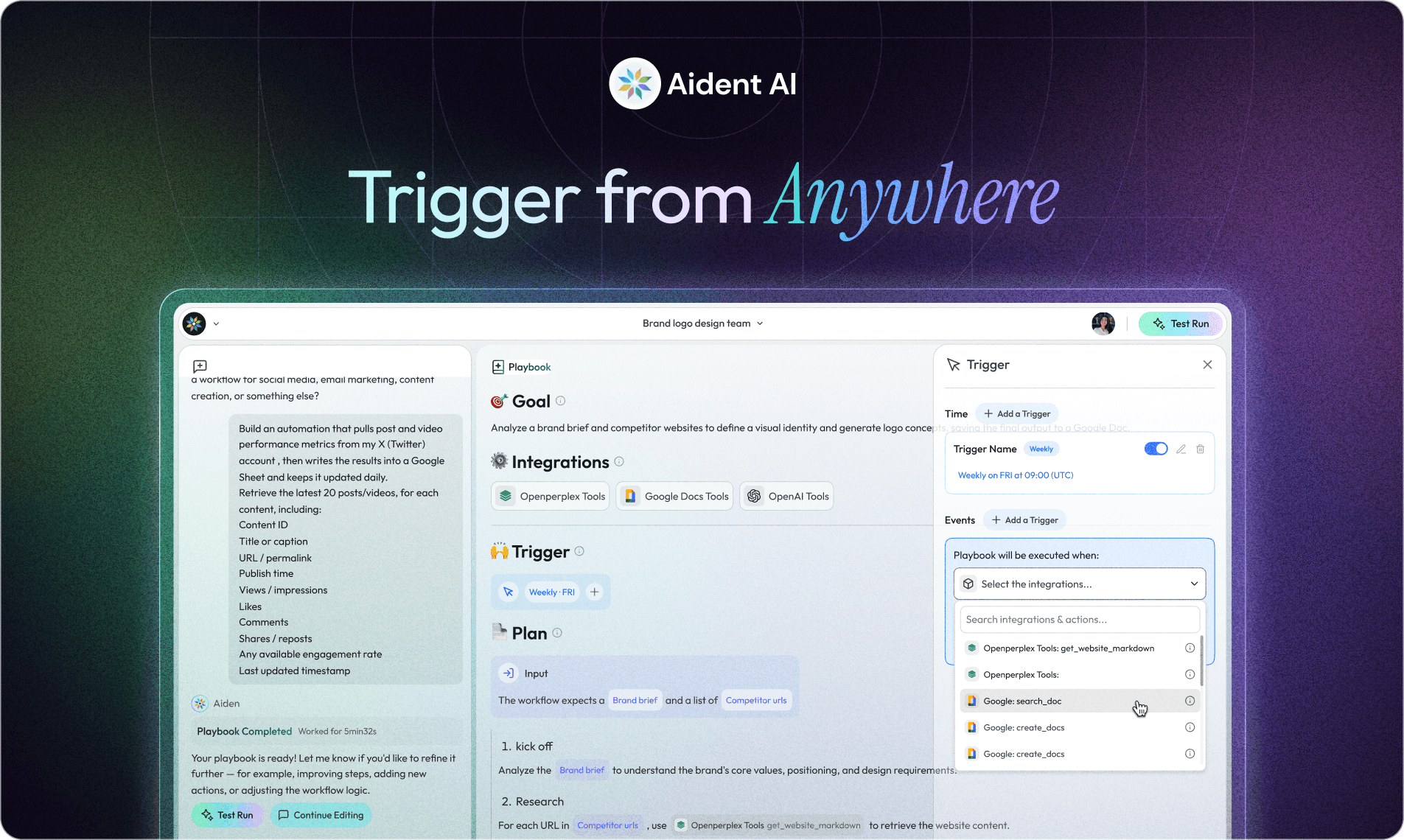
For event-driven delivery and retry design, see Trigger Workflows the Moment Work Happens.
FAQ
Can a workflow alert me when a competitor changes pricing?
Yes, if the price is publicly accessible and can be extracted reliably. Keep the original page URL in the alert and confirm important changes manually.
How often should I check a page?
Match the schedule to the likely rate of change and the site’s access rules. More frequent checks are not inherently more useful.
What should a useful digest contain?
Include only material changes, their previous and current values, detection time, confidence or validation status, and source links.
About the author
Jennifer Aio
Jennifer Aio graduated from the University of California San Diego in communication and has years of experience in marketing and sales for consumer- and SMB-facing products. At Aident, she covers growth, marketing, sales, and go-to-market strategy for products and businesses.



The one tool
for every tool
your agent needs.
Give any AI agent real capabilities in seconds. Connect 27,000+ tools once, skip the setup headache, and let your agents execute.