
Steve Wall
Project Management Is a Core Skill in the AI Era
It’s 9:07am on a Monday.
You open Slack and see five pings in a row:
“Weekly metrics report: FAILED”
“Competitor pricing monitor: Needs approval”
“Support triage agent: Escalated 3 edge cases”
“New lead enrichment: Rate limited”
“Calendar scheduler: Conflict detected”
None of these are “hard” problems. They’re just… everywhere. Each one is a tiny decision waiting for a human to unblock it.
AI didn’t reduce your workload—it changed its shape.
Execution is getting cheaper. But coordination is getting expensive.
And that’s why one of the most important skills of the AI era isn’t prompt engineering.
It’s project management.
Not the “update a ticket” kind. The orchestration kind: visibility → prioritization → decisions → delegation.
The Shift: From Doing to Orchestrating
For decades, career success meant being great at doing — writing code, closing deals, designing campaigns. AI is rapidly commoditizing execution.
What it can’t replace is the human layer above execution:
setting direction
prioritizing across competing goals
making judgment calls when reality deviates from the plan
maintaining accountability for outcomes
Think about what a typical knowledge worker’s day looks like in 2026:
A sales agent monitors leads and drafts outreach
A support agent triages customer tickets and escalates edge cases
A research agent scans competitors and surfaces insights
A scheduling agent coordinates meetings across time zones
A reporting agent compiles weekly metrics
That’s five autonomous agents operating in parallel—each producing outputs, hitting edge cases, and waiting for human decisions.
Without a system to orchestrate them, you’re not more productive.
You’re just drowning in a different kind of noise.
The people who thrive won’t be the ones who can do everything themselves. They’ll be the ones who can manage a portfolio of AI-driven workflows—knowing what to prioritize, when to intervene, and what to let run.
That’s project management. It is becoming a more broadly useful skill as teams delegate work to AI systems.
Why Existing Tools Fall Short
Most AI tools today are point solutions. Each lives in its own silo — a chatbot here, an automation there, a dashboard somewhere else.
So the “AI era” experience becomes constant context switching:
checking what ran
digging through logs
figuring out what failed
finding the one workflow waiting on you
remembering what you were doing before the interruption
The irony: AI was supposed to reduce your workload, but managing AI becomes a job in itself.
A Concrete Example: When a Playbook Fails Overnight
Here’s a representative scenario.
You have a “Competitor Pricing Monitor” playbook that runs every morning at 6am:
visits competitor product pages
extracts price + availability
updates a sheet
posts a summary in Slack
Over the weekend, the competitor site changes its layout and adds a bot check. Monday morning, the playbook fails.
What happens without orchestration
Someone notices the pricing sheet didn’t update. You hunt down the automation. You open logs. You try to interpret a half-readable error message. Meanwhile, you’re already behind.
What happens with the Aident Dashboard + Aiden
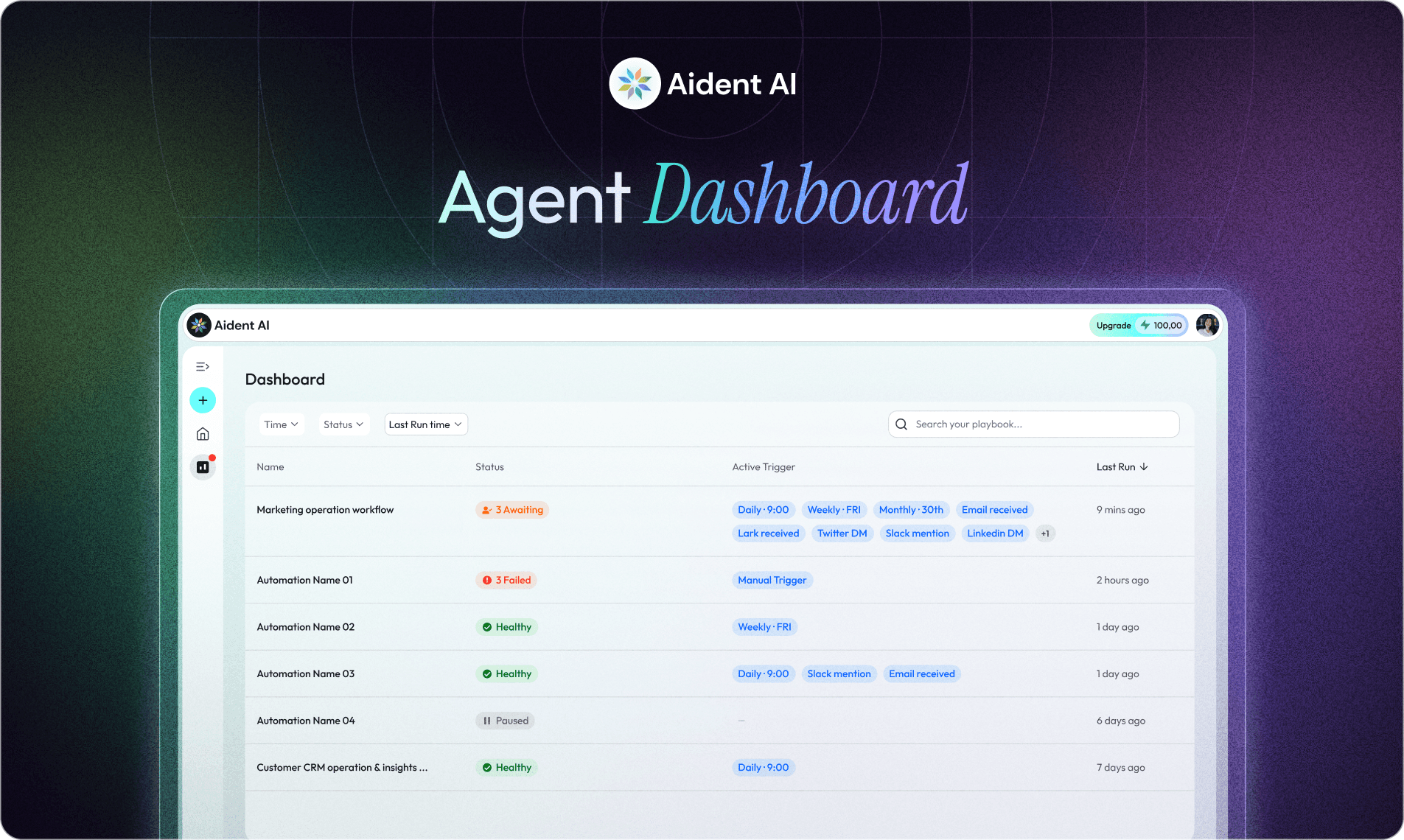
The Dashboard shows the playbook as FAILED with the trigger time and last successful run.
You click into execution history and immediately see where it broke (page fetch step).
You ask Aiden: “What changed and what should we do?”
Aiden replies with a plain-English summary:
failure reason (bot check / selector mismatch)
impacted downstream steps (sheet update + Slack summary skipped)
recommended fixes (switch strategy: API source, alternate pages, or add a human-approval checkpoint)
Then you choose the path:
approve a “human-in-the-loop” fallback for today (manual confirm one page)
update the extraction method
re-run the playbook
Aiden always confirms before acting. So you stay in control, but you’re not stuck doing detective work.
This is AI-era project management: fast triage + right-context decisions + delegation with accountability.
Introducing the Dashboard: Your Command Center
That’s why we built the Dashboard — a single pane of glass for every automation running across your business.
Open it up and you see all your playbooks at a glance. Each shows its status: healthy, awaiting your input, failed, or idle.
You can:
filter by failed status to triage quickly
filter by time to see what ran today
search by name
sort by last run time or status to see what’s active
When something needs your attention—like a workflow waiting for approval—you see it immediately, review the context, make a decision, and move on.
No log spelunking. No tool hopping.
The Executive Assistant: AI That Manages Your AI
A dashboard is great for scanning. But sometimes you don’t want to scan—you want to ask.
That’s why we introduced Aiden, our executive assistant agent.
Aiden can answer questions like:
“What playbooks failed in the last 24 hours?”
“Show me the execution details for my weekly report automation.”
“Set up a new automation to monitor competitor pricing.”
“Which integrations are connected and which need attention?”
Aiden doesn’t just read dashboards—it can take the next step: inspect execution history, check integration status, browse your skill library, and route follow-ups into workflows waiting on input.
And the key design principle stays the same:
Aiden always confirms before acting.
It’s an assistant, not an unchecked autonomous operator.
The Future Belongs to Orchestrators
As knowledge workers use more AI-driven workflows, orchestration starts to resemble managing a portfolio of delegated work.
The skills that matter most will look familiar to anyone who’s led a team:
Prioritization — Knowing what deserves attention vs. what can run unattended
Monitoring — Catching problems before they cascade
Decision-making — Stepping in at the right moment with the right context
Delegation — Letting agents execute while maintaining accountability
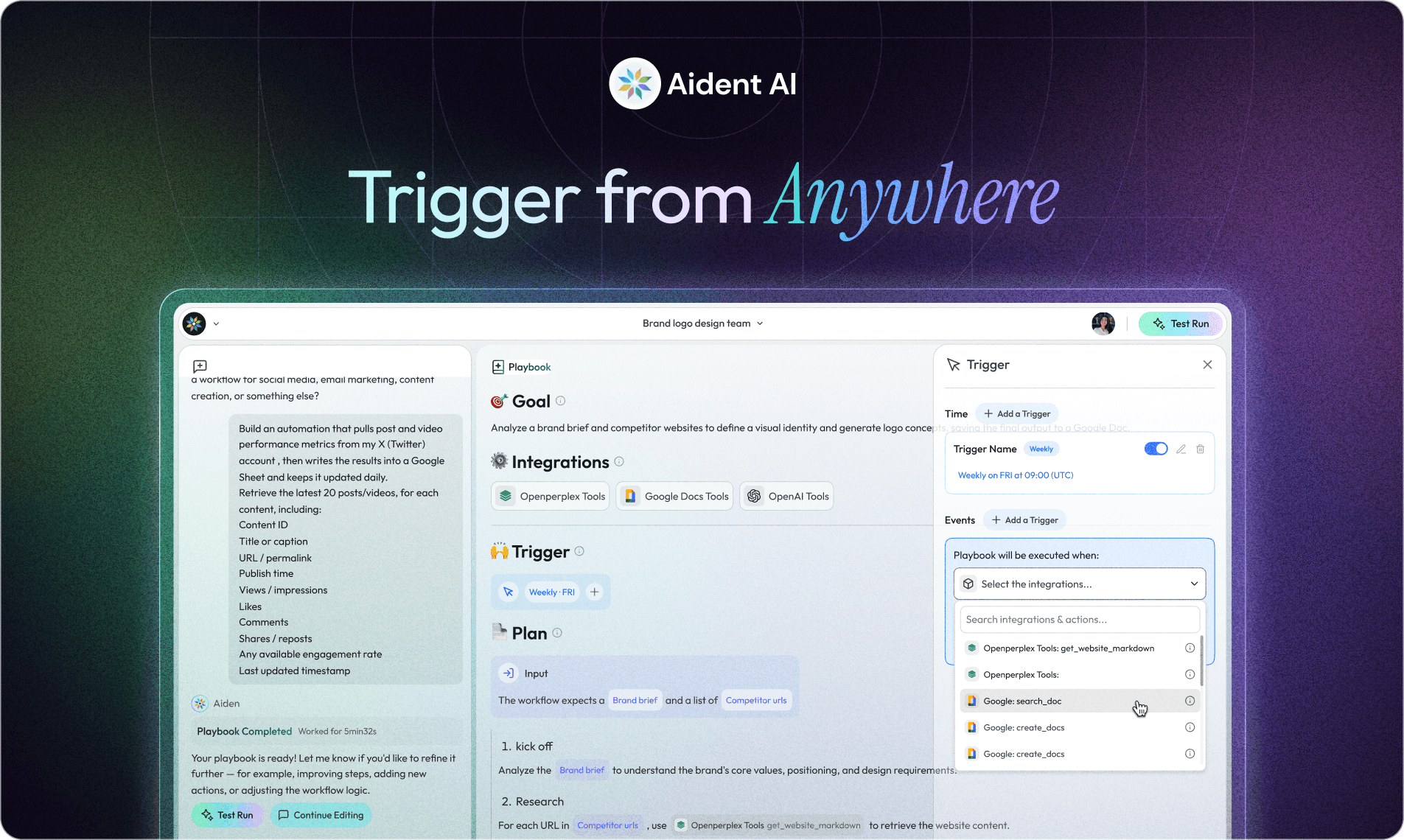
The practical lesson is to define ownership, monitoring, and escalation before adding more agents. For implementation patterns, read Trigger Workflows the Moment Work Happens and Loops Need the Real World.
About the author

Steve Wall
Steve Wall is an engineering and product leader with more than 20 years of experience in technology. He graduated from Carnegie Mellon University. At Aident, he covers technology and business trends, strategy, team building, resource allocation, and how organizations set and pursue high-level goals.



The one tool
for every tool
your agent needs.
Give any AI agent real capabilities in seconds. Connect 27,000+ tools once, skip the setup headache, and let your agents execute.