
Steve Wall

The Rise of MBAs, Once Again
AI agents are turning execution into abundant, on-demand capacity. Tokens are the budget that capacity consumes. When execution becomes abundant, the scarce skill shifts from doing the work to deciding what work deserves resources, how it should be organized, and whether it produced a result.
That is why MBA-shaped skills are becoming valuable again.
This is not a prediction about business-school enrollment, and it is not an argument that everyone needs a degree. "MBA" is useful shorthand for general management: strategy, finance, operations, organizational design, measurement, and control. Those disciplines were built for coordinating people and capital. AI-native individuals and organizations now need them to coordinate agents and tokens.
The next important AI interface may not be another chat box. It may be a management system.
Autonomous Agents Change the Unit of Work
The shift is visible across very different agent products.
OpenClaw describes itself as a personal AI assistant that runs on a user's devices and connects models, tools, messaging channels, and companion apps through a gateway. Hermes Agent adds a learning loop, persistent memory, scheduled automations, skill creation, and isolated subagents for parallel work. Grok Bot goes further in its organizational language: xAI describes digital teammates with cloud computers that can work across apps, run in parallel, continue while the user is away, and return for judgment calls.
These products are not interchangeable, and their popularity does not prove that autonomous agents are already dependable employees. They do point in the same direction. The useful unit is moving from a single prompt and response toward a persistent worker with context, tools, routines, responsibilities, and some ability to delegate.
Once that happens, the user's job changes. You are no longer only prompting a model. You are managing a small operating system for work.
The Bottleneck Moves From Intelligence to Management
Access to a capable model is becoming less differentiating. The harder questions sit one layer above it:
Which outcome matters enough to fund?
Which work should be handled by one agent, several specialists, software, or a person?
What context and permissions does each role need?
Which tasks can run in parallel without duplicating work?
What evidence must cross a handoff?
When should the system stop, escalate, or ask for approval?
How much should a result cost?
Who remains accountable when the agent is wrong?
These are management questions.
Anthropic's account of its multi-agent research system makes the point concrete. Its lead agent delegates to specialized workers. When assignments were vague, workers duplicated searches, left gaps, or interpreted the same goal differently. Better models did not remove the need for task boundaries, objectives, output formats, and a clear fan-in process.
That sounds less like prompt engineering and more like organizational design.
The Agent-Era MBA Curriculum
The 2026 Harvard Business School required curriculum spans finance, financial reporting and control, leadership and organizational behavior, marketing, strategy, technology and operations management, data science and AI, entrepreneurship, and corporate accountability.
The subjects are familiar because the management problem is familiar. The resources have changed.
General management discipline | Agent-team version |
|---|---|
Strategy | Choose the objectives worth pursuing and the work that should not be automated. |
Organizational design | Define agent roles, decision rights, tool access, handoffs, and one accountable owner. |
Operations | Design queues, dependencies, service levels, escalation paths, and recovery loops. |
Finance | Allocate token, model, Action, infrastructure, and human-review budgets to expected outcomes. |
Management accounting | Compare planned cost with actual cost and connect spend to accepted results. |
Leadership | Supply judgment when goals conflict, evidence is incomplete, or the environment changes. |
Governance | Set permission boundaries, approval gates, audit trails, and consequences for failure. |
The agent-native manager does not need to imitate a traditional corporation. A solo founder may run the same disciplines in a much smaller form. One person can set the objective, assign three agents, and review the result. The management problem still exists because work, money, risk, and accountability still exist.
Tokens Become a Management-Accounting Problem
Tokens are often discussed as an engineering constraint: context windows, rate limits, cache hits, and model prices. In an agent organization, they are also a management-accounting unit.
A token is not labor in the human sense. It has no ambition, welfare, or employment relationship. But tokens do fund machine effort. More context, more retries, more parallel workers, and more deliberation all consume budget. Tool calls, cloud computers, external APIs, and human review add further cost.
Optimizing the cheapest model is therefore too narrow. A cheap run that produces unusable work is expensive. A costly run that safely resolves a valuable problem may be efficient.
An agent-team scorecard should separate at least these measures:
Measure | Management question |
|---|---|
Cost per accepted outcome | How much model, tool, infrastructure, and review spend produced a result we kept? |
First-pass yield | What share of outputs passed the acceptance test without repair? |
Rework ratio | How much of the total effort corrected earlier agent work? |
Human-intervention rate | How often did the system need judgment, missing context, or approval? |
Cycle time | How long passed between assigning the objective and verifying the result? |
Parallel efficiency | Did additional agents shorten the critical path or merely duplicate work? |
Consequence-weighted failure | What was the cost and severity of wrong, incomplete, or unauthorized actions? |
Do not collapse this into one "agent productivity" number. A team can lower token cost while increasing rework. It can finish faster while taking more risk. It can execute every tool call successfully and still solve the wrong problem.
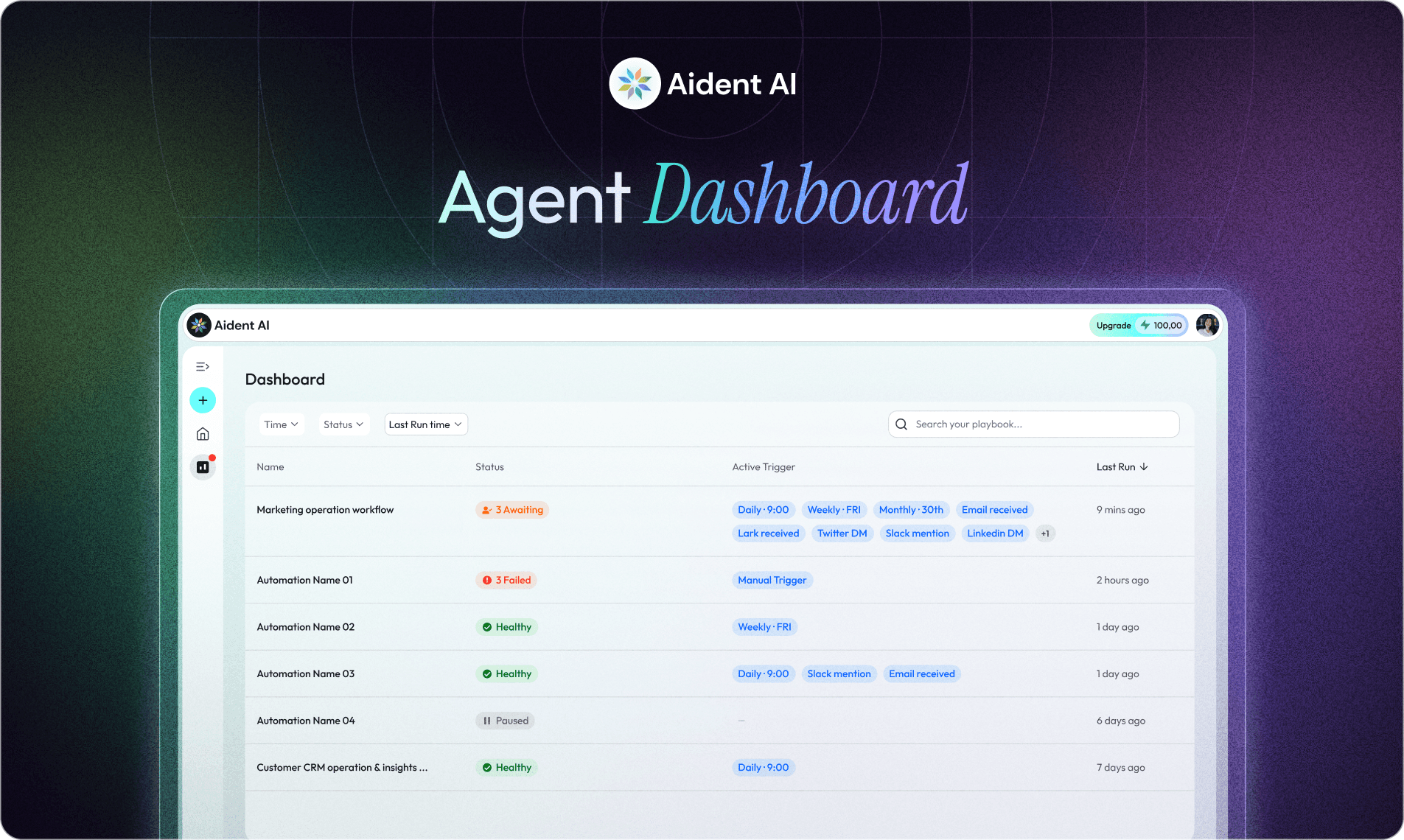
Aident's analysis of 4,187 production AI agent Action executions found a 78.3 percent terminal execution success rate in that bounded cohort. The article's more important conclusion was that successful execution did not prove correct tool choice, faithful interpretation, safe behavior, or completion of the user's objective. Results need several ledgers, not one flattering percentage.
Design the Work Before You Hire the Agents
Agent teams invite a familiar management mistake: adding headcount before understanding the process.
The better sequence is:
Name the outcome. Define the final state, acceptance test, deadline, and accountable human.
Draw the dependency graph. Separate work that can genuinely run in parallel from work that must remain sequential.
Assign narrow roles. Give every agent an objective, context boundary, tool set, output contract, and stop condition.
Budget the attempt. Set token, time, Action, retry, and human-review limits before execution.
Make handoffs carry evidence. Require sources, changed artifacts, validation results, stable IDs, and known risks.
Verify at the fan-in. Judge the combined final state, not the confidence of each worker.
Promote autonomy gradually. Expand permissions and unattended time only after repeated, measured success on the same class of work.
For an implementation-level example, Claude Code Graph Engineering shows how a lead, bounded workers, explicit dependencies, and a final verification node can coordinate a small agent team without confusing activity for progress.
The AI-Native Individual Becomes a Tiny Firm
Consider a one-person research and publishing operation.
A research agent finds current primary sources. An analyst identifies disagreements and missing evidence. A writer develops the argument. A verifier checks every claim and link. A publishing agent prepares the final artifact. The human chooses the thesis, resolves tradeoffs, approves publication, and owns the consequence.
The naive version asks five agents to "work on the article." The managed version gives each one a distinct decision, budget, input, output, and acceptance test.
The difference is not the number of agents. It is the operating model.
This is why AI-native individuals can begin to resemble tiny firms. They can deploy specialized capacity on demand, but they also inherit the firm's classic problems: resource allocation, coordination cost, internal controls, quality assurance, and strategic focus.
AI-Native Organizations Need an Agent Operating System
At organizational scale, the same pattern becomes more demanding.
Different teams will bring different agents, models, tools, and budgets. Without shared management infrastructure, the company cannot answer basic questions:
Which agent owns this recurring job?
Which systems can it access?
What did it spend?
What evidence did it use?
Which approval allowed the action?
Did the work reach the intended business state?
Is another agent already doing the same job?
The answer is not one giant supervisor with universal permissions. It is a legible operating system: a catalog of capabilities, scoped identities, explicit budgets, observable handoffs, evaluation sets, approval boundaries, and outcome accounting.
If you want to test that model with one real job:
Follow https://aident.ai/SETUP.md
Then give your coding agent a bounded, read-only objective and ask it to use Aident Loadout to discover the relevant Action, inspect its live schema and connection state, preflight the exact input, execute only within the stated budget, and return the cost, evidence, result, and unknowns. The point is not to add another agent. The point is to make delegated work inspectable.
The MBA Is Back, but the Org Chart Has Changed
The builder era made management easy to caricature as overhead. The agent era reveals why management existed in the first place.
When productive capacity is scarce, the person who can do the work is the bottleneck. When productive capacity becomes cheap and parallel, the bottleneck becomes the person who can choose, structure, fund, measure, and govern the work.
That does not make every manager valuable. It makes good management more valuable.
The winners in the agent economy will not be the individuals or companies running the most agents or burning the most tokens. They will be the ones that convert machine effort into reliable outcomes with the least coordination waste and the clearest accountability.
That is the rise of MBAs, once again. Not necessarily the credential. The craft.
Read Project Management Is a Core Skill in the AI Era for the practical monitoring, prioritization, intervention, and delegation habits behind this operating model.
Sources
Grok Bot is now included with more plans, xAI, August 21, 2026
How we built our multi-agent research system, Anthropic
Building effective agents, Anthropic
Refresh this article when OpenClaw, Hermes Agent, or Grok Bot materially changes its autonomy or team model, when credible outcome data replaces product-level adoption signals, or when a comparable agent-team cost benchmark changes the proposed management scorecard.
About the author
Steve Wall
Steve Wall is an editorial pen name used by Aident's workflow-research team. This column covers automation platform selection, adoption tradeoffs, and measuring workflow outcomes. Comparisons make their criteria, sources, assumptions, and limitations explicit so readers can evaluate the evidence for their own situation.





The one tool
for every tool
your agent needs.
Give any AI agent real capabilities in seconds. Connect 27,000+ tools once, skip the setup headache, and let your agents execute.